
The Context
The development of the GCRI conflict model started in 2014 to provide an accessible, objective and open-source evidence base to support the EU’s conflict prevention capacities and decision-making on long-term conflict risks. The output of the GCRI serves as the quantitative input to the EU conflict early warning framework for identifying countries at high risk of conflict and those whose risk is worsening significantly:
Building on previous work by the European Commission’s Joint Research Centre (JRC), JRC in consultation with the European External Action Service (EEAS) elaborated a methodological framework that includes a variety of structural indicators. The main goal was to rethink the concept of ‘risk of conflict’ by clustering conflicts into certain dimensions, before determining in a second step a set of associated indicators that are said to contribute to the outbreak of violence.
Data and methodology
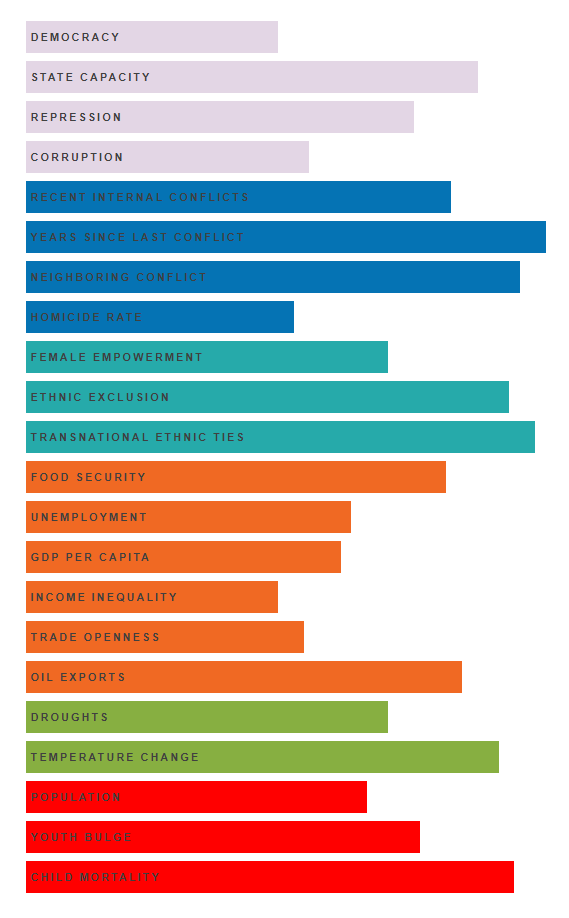
The GCRI covers 22 variables in 6 dimensions (social, economic, security, political, geographical/environmental, demographic) reflecting structural conditions correlated to the occurrence of violent conflict. The GCRI uses historical data since 1991 to train the model, which is then used to forecast conflict risk in the next 1-4 years. Conflict risk scores relate to the following types of conflict: (1) Any conflict, (2) State-based conflict, (3) Non-state conflict and (4) One-sided violence.
 AFPCS
AFPCS 