Data Analysis of 90-day Protests in Canada
Funded: Global Affairs Canada
Principal Investigator: Dr. Hamed Kazemzadeh
Research Assistant – Data Analyst: Annisha Plesche
Researchers: Jonathan Groff, Emboba Antigo, Sara Hassan, Mohhamad d. Qayomi
Project: 2023-2024
First Summary Report
Following the outbreak of the Israel-Hamas armed conflict in October 2023, thousands of Canadians have demonstrated in support of both Palestine and Israel in major cities. Most of them have taken place peacefully, demanding a permanent ceasefire between parties and the release of hostages and prisoners. Unfortunately, it led to a new internal wave of anti-Semitic and Islamophobic hate speech spiked across the country.
Since October, multiple demonstrations have been held in several Canadian cities to show support for Palestinians and Israel. The first gathering was in Mississauga, Ontario, in support of Palestinians and celebrated Hamas’ attack. Since October 8, routine pro-Israel and pro-Palestine rallies began across Canada as the war continued.
The table below shows the approximate number of demonstrations by province in Canada. In general, 243 pro-Palestinian rallies and 57 pro-Israel rallies occurred in various Canadian cities from October 7 to December 31. The number of these events only includes outdoor protest gatherings and does not include indoor gatherings or funerals and vigils for the victims. Also, in the following data, if the counter-protests have been held, two separate events have been recorded:
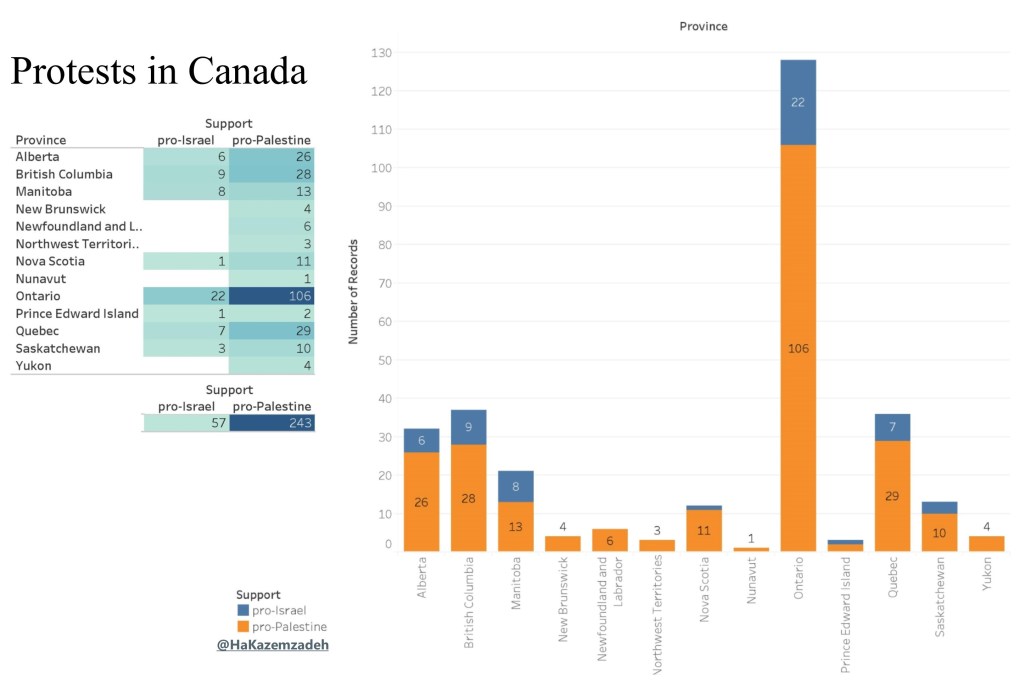
Most of the sources of this analytical report included the police data, the Global Protest Tracker, Angus Reid Institute, the Armed Conflict Location & Event Data Project , the Amnesty International Canada, and Canadian medias in the field of civil society. The most significant number of demonstrations took place in Ontario and Toronto. The pro-Palestine rallies have been held mainly following the call of the Palestinian Youth Movement, the Ceasefire Now Coalition, Palestinian, Arab, and Muslim institutions, and antiwar groups in the country. The pro-Israel rallies were primarily organized by the Israeli-Canadian Council and the CJA Federation. Still, it should be noted that many indoor rallies are not mentioned in the above statistics. In the table below, you can see the groups organizing rallies based on ACLED data:
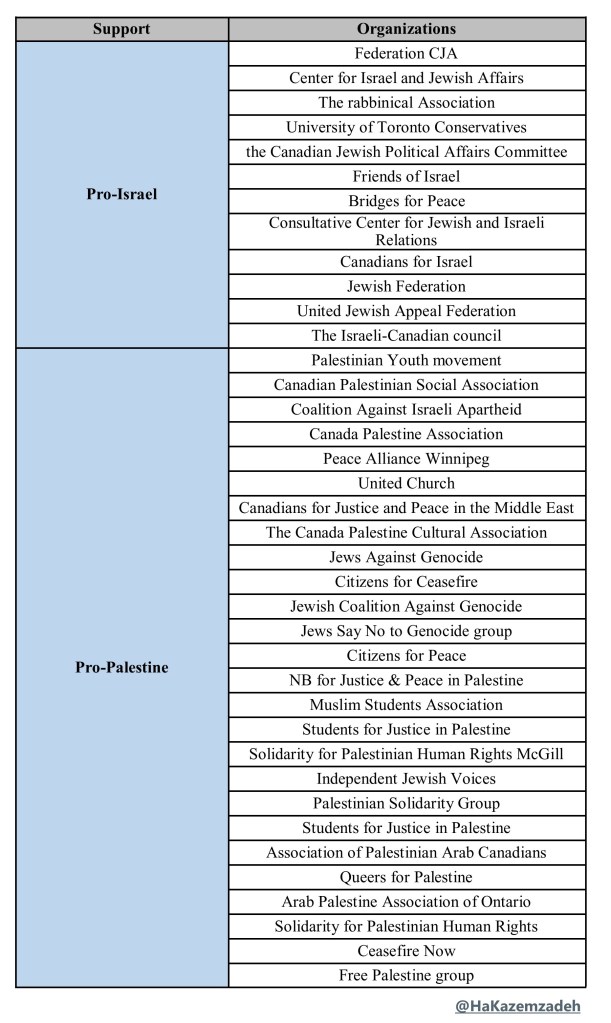
The largest coalition of Palestinian supporters is the Ceasefire Now group, which was formed on October 21 with the slogan of a just and sustainable peace and includes 272 Canadian organizations. In checking the number of gatherings, the data of this group is also beneficial, but ACLED did not use it based on its methodology. If I add the statistics of this group to the data, the number of pro-Palestine rallies will reach 390. Also, based on the police data in Toronto, only 250 rallies have been held until December 22, which are not counted in the above statistics.
At some times, as you can see in the table below, we see an increase in the number of demonstrations, especially by supporters of Palestine, which depends on the war situation in the Gaza Strip. For example, during the days when Israel’s ground operation began or the Al-Shifa Hospital siege took place, there were the largest nationwide demonstrations in the country. Another point that can be analyzed from these statistics is the type of events. In the table on the right side, you can see three types of events: protests with police intervention, peaceful demonstrations and other.
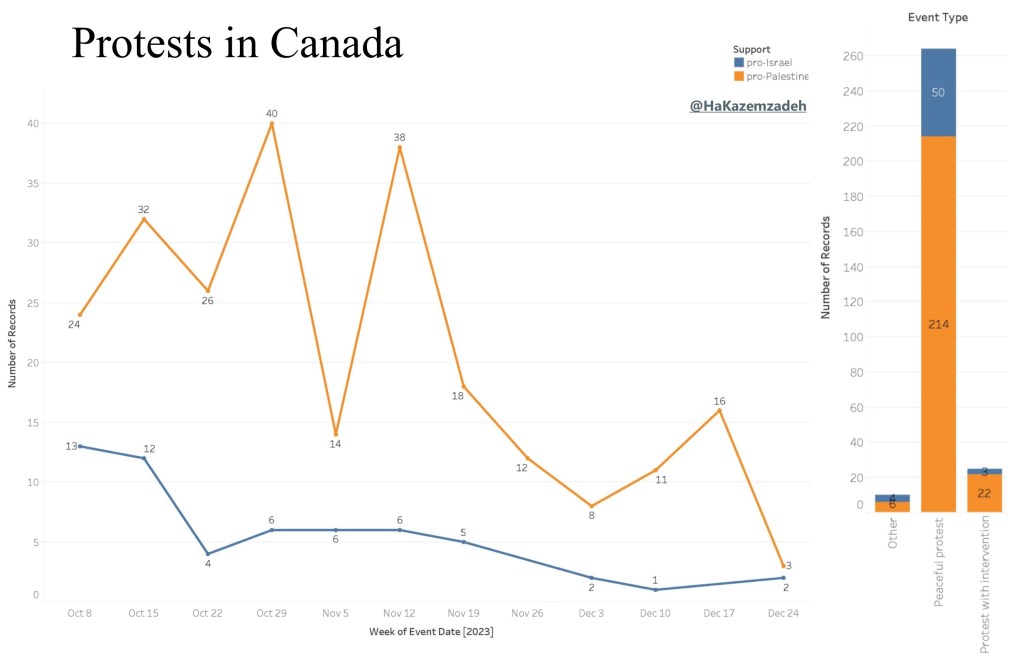
Most of the rallies have been peaceful, but in limited cases, there have been police intervention, and serious clashes erupted between the supporters of both sides. Each incident in which a police arrest and a physical confrontation with injury occurred at simultaneous pro-Palestinian and pro-Israel rallies was recorded separately. The number of these incidents is about 25, which, over time, with the management of the police and the coercion of the parties not to hold counter-protests, decreased to a large extent in the last month:
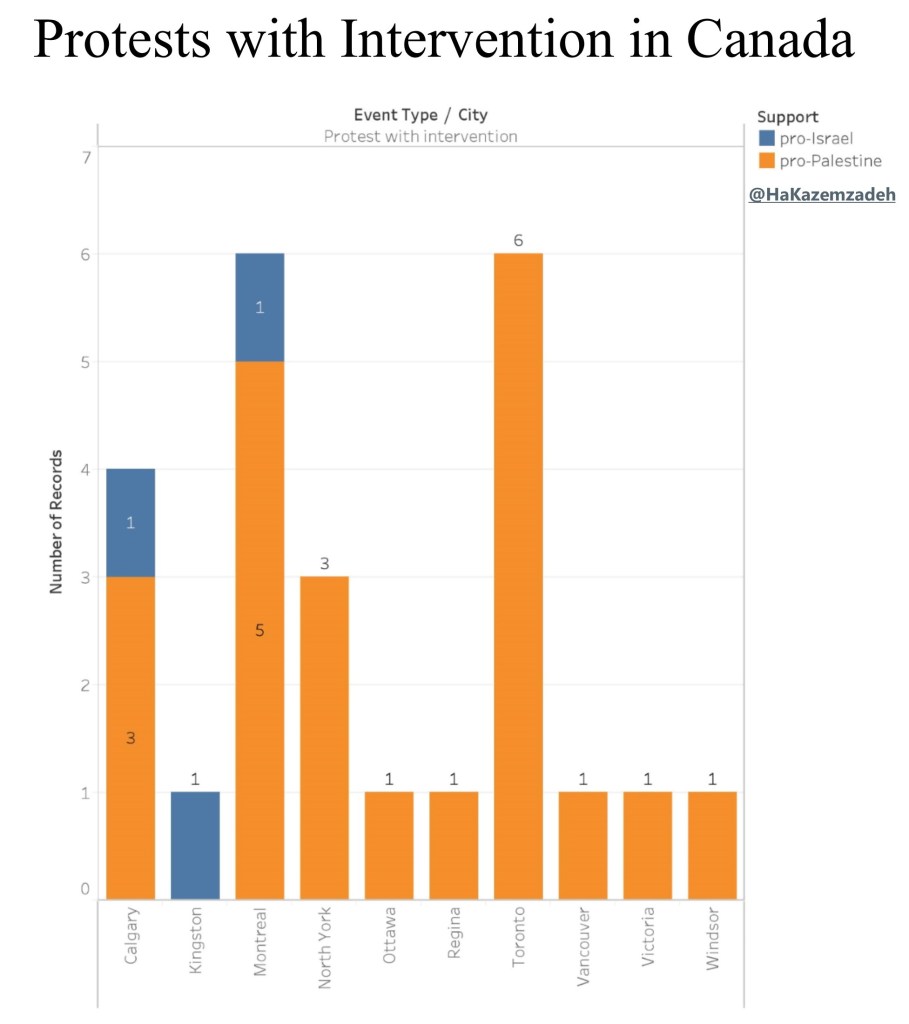
Other events include the destruction of places related to Jews or Muslims and racist attacks motivated by Islamophobia and antisemitism as hate crimes. This data only recorded ten critical incidents in these 90 days, but the police report mentioned more. For example, in a series of security incidents on November 6, 9, 12, and 27, Jewish centers and schools in Montreal were attacked with Molotov cocktails and gunshots. In another example, on November 16, the Jafari Shia community center was evacuated due to an alleged bomb threat. However, there have been nearly 100 hate crimes reported to Toronto police since the onset of the Israel-Hamas war on October 7, more than double the number observed during the same period last year.
Another interesting point the data gives us is the presence of various Canadian ethnic and religious groups in the rallies. In the table below, you can see some social groups supporting one of the sides of the conflict. These groups were added to the statistics only when at least one person from that social group had an active presence in one of the gatherings, as an organizer or as a speaker, and that group was directly mentioned in the news related to that protest:
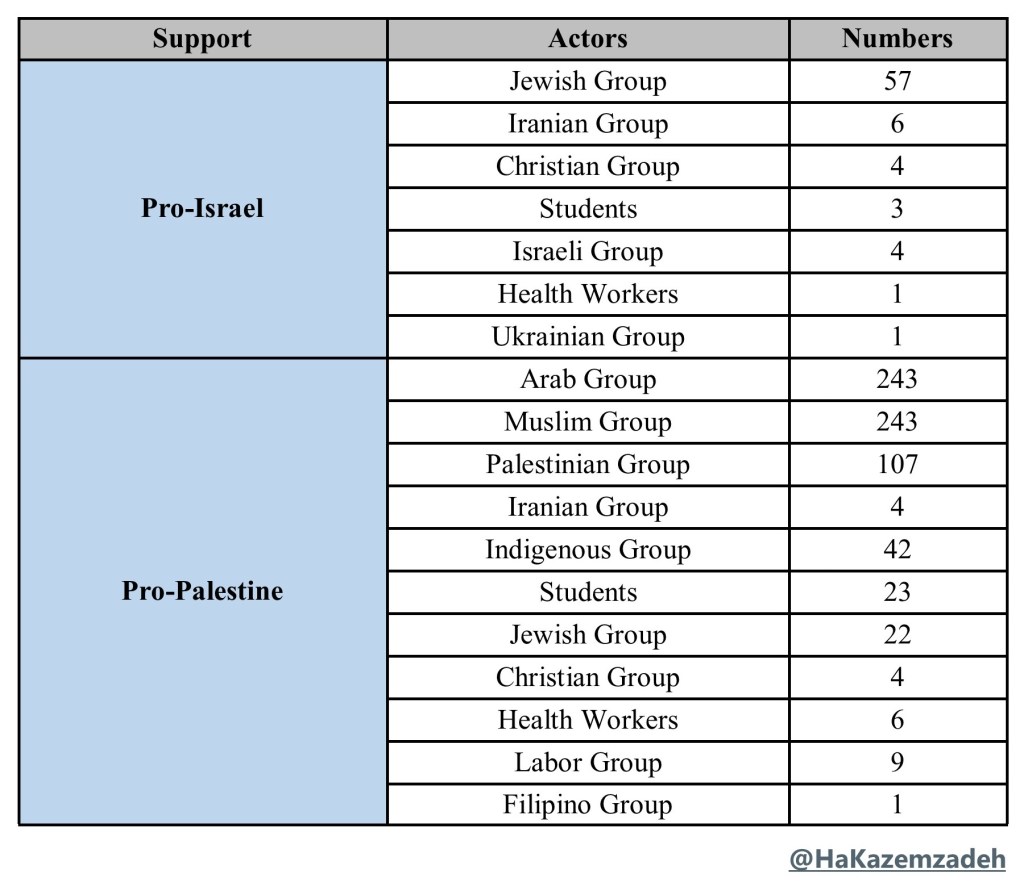
Canada’s Indigenous groups (First Nations, Métis and Inuit) have also played a key role in pro-Palestinian rallies. They have actively participated in at least 42 gatherings and are traditionally considered allies of Palestinian groups.
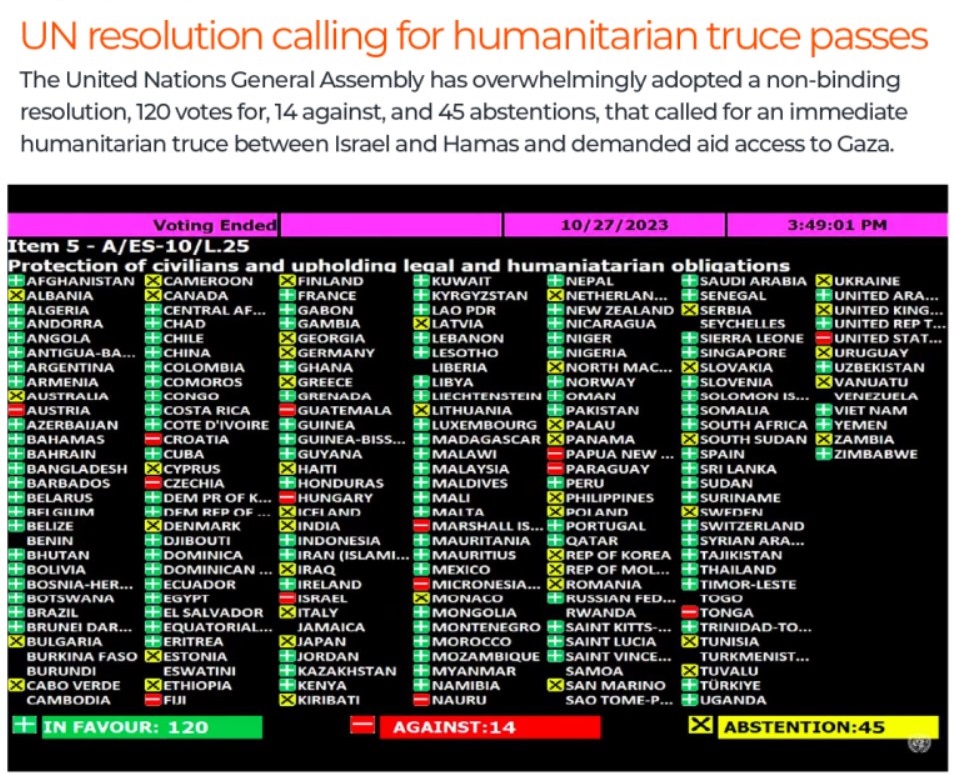
These social developments and civil society’s actions in Canada, including national demonstrations in front of the MPs’ offices, ministries, and legislative assemblies, somewhat caused the federal government’s policy to change over time. This is more visible in the UN resolutions. In the first resolution in the United Nations General Assembly, which was approved on October 27 by a recorded vote of 120 in favour to 14 against, with 45 abstentions, the Assembly adopted the resolution titled “Protection of Civilians and Upholding Legal and Humanitarian Obligations” (document A/ES-10/L.25), demanding that all parties immediately and thoroughly comply with their obligations under international law, including international humanitarian law. Canada did not participate in this vote and was recorded as abstention:
After this voting and criticism of the government, on November 14, Justin Trudeau said the “killing of women, of children, of babies” in the besieged Gaza Strip must end, in his sharpest criticism of Israel. Then, on December 9, The Federal Government hosted a meeting in Ottawa with a delegation of foreign ministers from Saudi Arabia, Türkiye, and the Palestinian Authority to discuss the ongoing conflict between Israel and Hamas and the path toward lasting peace in the region. Prime Minister Trudeau reaffirmed “Canada’s commitment to achieving a just, lasting, and comprehensive peace in the Middle East, through a two-state solution, with a Palestinian state living side-by-side with Israel.” After this diplomatic process and social developments, on December 11, Foreign Affairs Minister Mélanie Joly explained Canada’s revised foreign policy towards the Israel-Hamas war in a conversation with the “Power & Politics” CBC TV show.
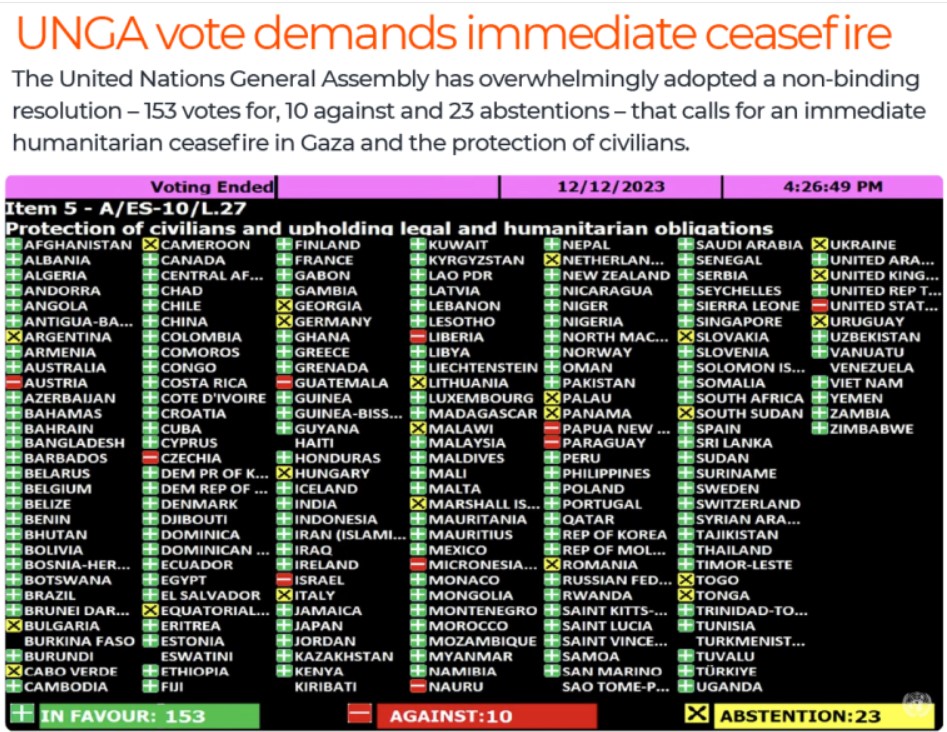
On December 12, the United Nations General Assembly again adopted a new resolution, demanding an “immediate humanitarian ceasefire,” the immediate and unconditional release of all hostages and “ensuring humanitarian access,” with a large majority of 153 in favour and ten against, with 23 abstentions. Canada’s presence in this vote was the first official sign of a change in Canada’s approach to this conflict:
In these 90 days, we witnessed continuous rallies supporting peace in at least 90 countries. Most of these gatherings were done by the supporters of Palestine, but the supporters of Israel also emphasized the issue of peace between the parties. This is the turning point between these two streams, which, regardless of their bias, have raised a call for peace. Based on statistical data, Canadians have been among the organizers of most pro-peace gatherings worldwide. This is a clear message to Canadian politicians that their people, both pro-Israel and pro-Palestinian, support sustainable peace, and the Palestinian Question in the Middle East could have a direct impact on social security and foreign policy.
Another phenomenon that seems to be worrying is the issue of hate speech in the country. Unfortunately, it is a reality that hate crimes and hate-motivated (Islamophobia and Antisemitism) incidents in Canada are rising. Muslim and Jewish advocacy groups say there has been a steeper increase in hate speech since the conflict started, most of which they say are not reported to police. There is a growing global concern about the increasing trend of attacks, punishment, and restrictions on freedom of expression and peaceful Assembly faced by people who speak out in support of the victims of the Israel-Palestine conflict.
For example, in November, a Senate report on Islamophobia found that many Muslims in Canada experience Islamophobia daily. Based on this report, Islamophobia remains a persistent problem in Canada, and concrete action is required to reverse the growing tide of hate. The report emphasizes that the problem can be blamed in part on negative and pervasive stereotypes of Muslims, which mischaracterized concepts of sharia, jihad and hijab.
According to the Toronto Police, from October 7 to December 17, there were 20 incidents of anti-Palestinian, anti-Muslim and anti-Arab hate crimes, which is a significant increase from the two incidents reported during the same period last year. Additionally, there were also 56 reported incidents of anti-Semitic hate crimes, which is a significant increase from the 18 incidents reported during the same period last year.
In Montreal, a surge in hate-crime cases has been recorded since October 7, with police adding the most recent incidents to a list of another 41 targeting Jewish people and 14 targeting Arab-Muslim communities. In Ottawa, there were 64 reports between the start of October and November 6, compared to 41 during the same period last year. To deal with this phenomenon, the federal government appointed a special representative (Amira Elghawaby, Special Representative on combating Islamophobia) and a special envoy (Deborah Lyons, Special Envoy on Preserving Holocaust Remembrance and Combatting Antisemitism) to advise the federal government on how to combat antisemitism and Islamophobia to counter the rise in hate in Canada amid the ongoing Israel-Hamas war.
Many social activists and political thinkers in Canada are aware of the increase in antisemitism, Islamophobia, racism, and hate speech in these 90 days. They are all worried about the polarization of elites, people, and society. But everyone has come to the same belief that in the case of proper management by the political rulers, Canada can respond to this social demand to play a better role in peacemaking, peacebuilding and mediation to speed up the peace negotiation process. More efforts from the government and policymakers to solve the problem can play a constructive role in reducing hatred in the country. The Angus Reid Institute’s report correctly states that the government’s actions in political decisions have helped to reduce this social tension and strengthen national solidarity in line with Canada’s multiculturalism policy. The social consequence of this policy can increase national convergence even in the Palestinian Question, make the parties of both streams more aware of each other’s ethnic, religious and political sensitivities and expand cultural and social resilience among the layers of Canadian society. Right now, it seems our society needs respect for religious, cultural and political pluralism and the affirmation of diversity more than ever.

